

The Ancient Roots of Timber Piling
The use of timber piles dates back to prehistoric times, with early evidence found in stilt houses across the lakes of Switzerland and Italy, dating back to 5000 B.C. These early applications highlight timber’s availability, ease of use, and inherent strength, qualities that made it an ideal choice for supporting structures in challenging environments, such as soft soils or near bodies of water.
In the Roman era, timber piles were extensively used for the foundations of bridges, aqueducts, and buildings, showcasing their ability to provide stable support for massive structures. Notably, the foundation of Venice, a city famed for its resilience against the test of time and water, rests on millions of timber piles. These historical instances exemplify the durability and reliability of timber piling when properly utilized and maintained.
Are you looking for a reliable marine construction partner? Call us at (516) 785-7557 and let us know how we can help with your next engineering project.
Lessons in Durability and Sustainability
One of the key lessons modern practitioners can draw from historical use is the importance of selecting the right type of wood and treating it to withstand environmental factors. Ancient builders often chose hardwoods like oak, which naturally resist rot and pests, for their piling projects. Today, timber piling contractors have access to a wider range of treatment options to enhance the durability of softer woods, making timber piling an even more versatile choice for construction.
Sustainability is another lesson from the past. Ancient civilizations utilized locally sourced materials, minimizing the environmental impact of their construction activities. In the contemporary context, timber is recognized as a sustainable resource, especially when sourced from responsibly managed forests. The carbon-sequestering nature of wood also adds to its environmental benefits, making timber pile construction services a green choice for modern projects.
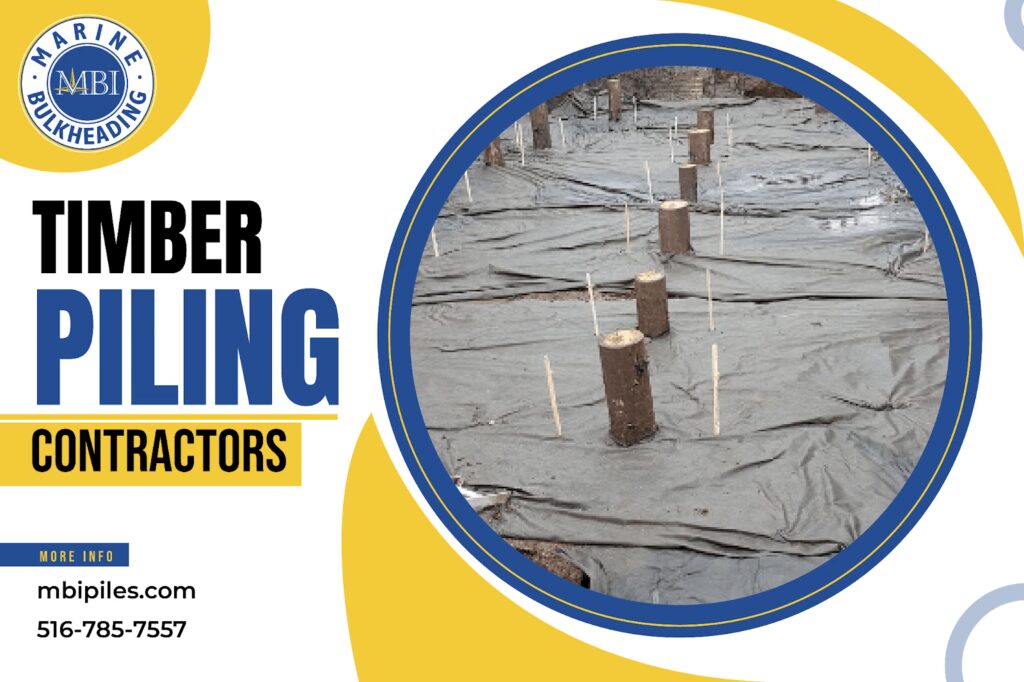
Timber Piling for Structural Stability
The historical use of timber piling underlines its effectiveness in providing structural stability. Ancient builders intuitively understood the engineering principles that modern science now explains: timber piles can distribute the load of a structure evenly through soft soils, preventing sinking and settling. This principle is especially relevant today in areas prone to soil liquefaction during earthquakes, where timber’s flexibility and resilience can offer added safety and stability.
Modern timber piling contractors now have advanced techniques at their disposal, such as driven piles and helical screws, which can be adapted to various soil types and environmental conditions. These contemporary methods, rooted in historical practices, ensure that timber piling remains a reliable foundation solution.
Call (516) 785-7557 today to discuss your project needs with our experts and discover how we can support your marine construction requirements.
Adapting Historical Insights for Modern Challenges
The challenge of building on soft or unstable ground is not new, and the historical reliance on timber piling provides a blueprint for modern engineers. Today’s construction projects, whether residential buildings, commercial complexes, or infrastructure such as bridges and piers, can benefit from the lessons learned over millennia of timber piling use.
Innovation in timber treatment and preservation techniques can extend the life of timber piles even further, making them more resistant to water, pests, and decay. Modern analytical tools and engineering practices also allow for precise calculation of loads, stresses, and environmental impacts, optimizing the design and installation of timber piles for maximum safety and longevity.